Every one of those meals has to be prepared, portioned, served, and cleaned up within tightly structured windows, often by teams juggling multiple meal periods, multiple buildings, and a production schedule that resets every 24 hours.
During the busiest months of the school year, when participation peaks and menus rotate through labor-intensive items, there is less room to absorb friction in the workflow. This is not a restaurant environment where a slow ticket gets absorbed by the next one. School foodservice operations run on fixed schedules, fixed budgets, and defined service periods.
With teams balancing higher demand, limited resources, and increasing expectations around from-scratch preparation, what matters most during these stretches is not effort. It is having workflows and tools that make high-volume, repetitive production manageable without adding steps, complexity, or cost.
Consistency Becomes Harder as Meal Volume Increases
Consistency in school meal production is not an abstract goal. It means the baked chicken served on line two looks, tastes, and portions the same as the batch on line one. It means the school across the district running the same menu produces a comparable result. And it means the third batch of macaroni and cheese coming out of the oven at 11:45 holds up the same way as the first batch at 10:30.
That kind of repeatability gets harder as volume increases. More batches mean more chances for variation in cook times, ingredient ratios, or pan preparation. More serving lines mean more people executing the same steps, sometimes with very different levels of experience. Multiple buildings served from a single production kitchen introduce transportation and timing variables that simply do not exist in a single-site operation.
The challenge is not a reflection of how well these teams execute. It is built into the environment they are working in. When pan preparation varies across a busy shift, food sticks in some pans and releases cleanly in others. Portioning becomes uneven. Presentation shifts. These are small breakdowns, but at scale, they compound quickly, affecting both food quality and student satisfaction.
Even for teams that run a tight operation, building preparation processes that are simple enough to repeat accurately, shift after shift, is the most reliable path to consistency. That includes how pans are prepped, how food is portioned into those pans, and how production is organized so that each batch follows the same sequence.
Make Every Staff Hour Count
The numbers tell a clear story. According to the School Nutrition Association’s SY 2024/25 Trends Report, 71.6% of school nutrition program respondents reported at least one current staff vacancy. The overall vacancy rate of 8.7% exceeds the 6.2% rate for the broader accommodation and food services industry, as reported by the Bureau of Labor Statistics. Larger districts reported even higher rates.
But whether or not a given kitchen is short-staffed on a particular day, the underlying reality does not change: staff time is finite. How it gets allocated determines how smoothly service runs.
One of the less visible pressures these teams face is how much time disappears into tasks that never touch the food. Pan scrubbing is the clearest example. A kitchen running lunch service across two or three periods may cycle through dozens of hotel pans in a single shift. Each one needs to be emptied, scraped, soaked, scrubbed, rinsed, and sanitized before it can go back into rotation. That cycle pulls staff away from the work that actually drives the next round of production:
- Prepping ingredients for the next batch
- Portioning food into pans for the upcoming service period
- Restocking serving lines mid-service
- Getting ahead on afternoon meal prep
The goal is not to eliminate necessary tasks. It is to shrink the time consumed by repetitive ones so available staff stay focused on preparation, cooking, and service. During the busiest months, when meal counts climb and batches per day increase, even small opportunities to simplify that cycle can make a meaningful difference for teams already stretched thin.
High-Volume Meal Service Requires the Right Workflow
School meal production operates differently from most commercial kitchens. A restaurant might serve 200 covers over a three-hour dinner window with continuous ticket flow. A school kitchen might need to produce 800 lunches in 90 minutes across two service periods, with everything prepped, cooked, and staged before the first bell rings. That is not a busier version of the same job. It is a fundamentally different production model.
Volume at that level depends on batch production. Items are prepared in hotel pans, often in waves: the first batch goes into ovens or steamers early, the second follows at a staggered interval so that fresh food is available throughout service. Timing matters more than most operators realize. If pans are not available because they are still being scrubbed from a previous batch, the next wave of production stalls. In kitchens running on a limited pan inventory (which many school kitchens do), pan turnover becomes a bottleneck that affects the entire schedule.
Movement from preparation to service adds another layer. In districts that transport food from a central production kitchen to satellite schools, pans need to be filled, covered, loaded, and delivered on a schedule. Any delay at the production end cascades through the delivery window. At the satellite level, staff receiving those pans need to transfer food to steam tables and begin service quickly, often with minimal kitchen infrastructure.
A reliable workflow means thinking about the full sequence: how pans are prepped, how batches are timed, how pans move from oven to service line, how quickly they can be turned over, and how cleanup fits into the production cycle rather than piling up at the end of the shift.
Most breakdowns during peak months trace back to one of these handoff points, not to the cooking itself. That is not a criticism of the teams managing these operations. It is a reflection of how many moving parts school meal service actually involves.
Food Quality Still Matters at Scale
High volume creates pressure to prioritize speed over quality, but School Nutrition Directors know that food quality directly affects participation. Students who find the food unappealing skip the line. Declining participation affects both the nutritional mission and the program’s financial sustainability. There is no version of this where quality is optional.
Several practical factors influence food quality in a high-volume school kitchen, and most of them come down to how food interacts with the pan. Food that sticks to unlined pans loses moisture, browns unevenly, and becomes difficult to portion cleanly. A pan of baked ziti that has to be scraped out of corners yields fewer usable servings and produces plates that look less appealing. Multiply that across several pans and several hundred students, and the waste adds up in both food cost and presentation.
Moisture retention during cooking and holding is another factor that is easy to underestimate. Food that dries out during the gap between preparation and service loses flavor and temperature. Maintaining consistent quality from the first serving to the last, especially when food is held on a steam table through multiple service periods, requires attention to how food contacts the pan surface and how well the serving setup maintains temperature.
When teams are managing multiple meal periods under time pressure, having the right tool matched to the right application helps. A pan liner designed for oven use serves a different function than one designed for steam table holding. Using the appropriate product for each application helps maintain consistency and reduces the risk of food quality issues that stem from equipment mismatch, not preparation error.
Small Operational Changes Can Support the Entire Program
The challenges described above do not exist in isolation. Inconsistent pan preparation affects food quality. Slow pan turnover delays batch timing. Excessive cleanup workload pulls staff away from production. Address any one of these on its own and it helps, but the real gains come from changes that touch multiple points in the workflow at once.
This is where practical tools earn their place in a school kitchen. Not by adding steps. By fitting into the production process that already exists and helping teams that are already doing demanding work operate with a little less friction.
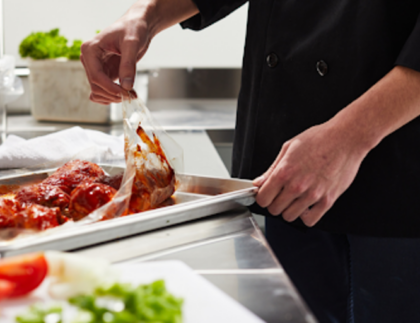
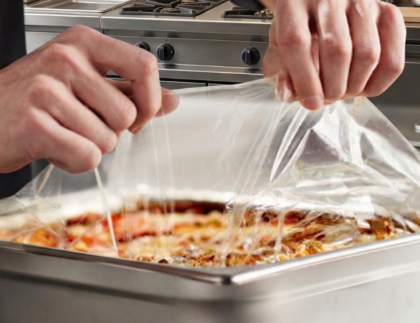
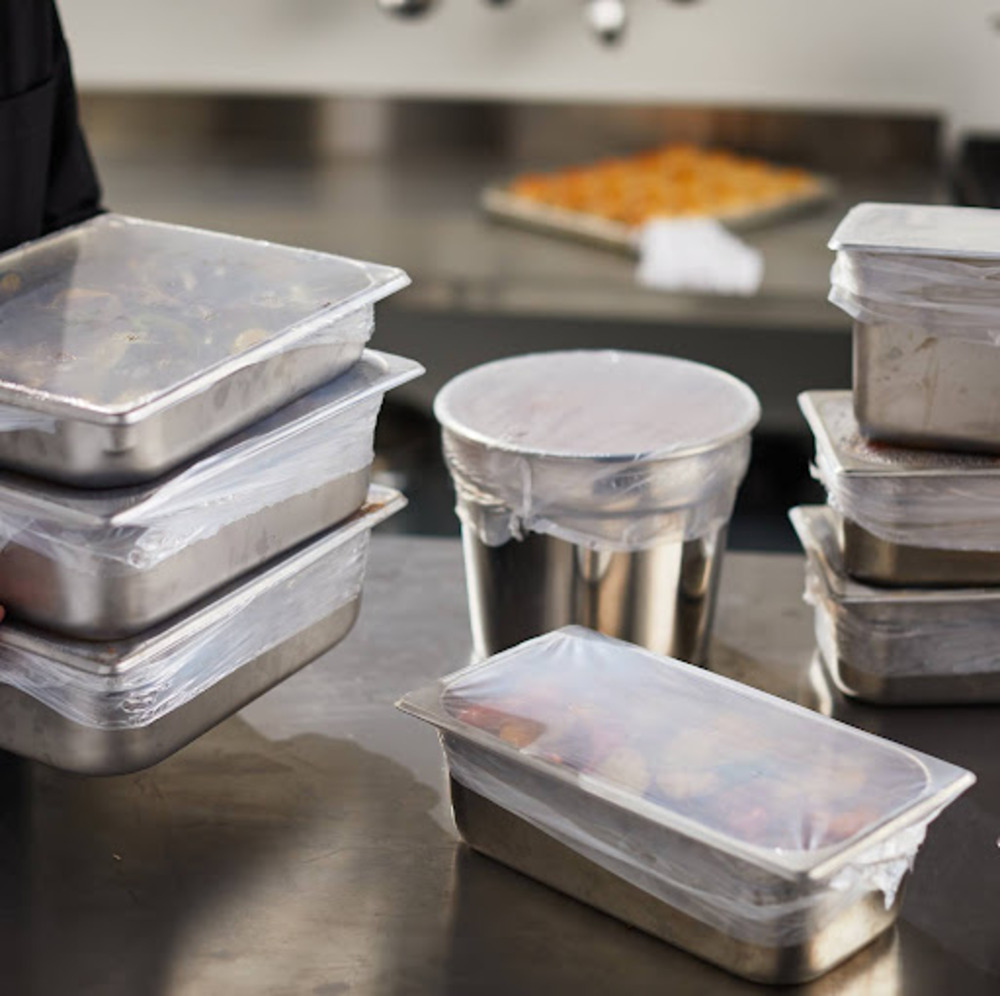
PanSaver Ovenable Pan Liners are one example. Lining hotel pans before cooking eliminates baked-on food, which means the pan releases food cleanly and reduces waste. Their Contour-Fit® design hugs the pan corners so food does not get trapped where a serving spoon cannot reach. The result: more usable portions per pan and more consistent presentation from batch to batch.
These liners are oven-safe to 400°F and work across food preparation, cooking, and holding. After service, the liner is removed and the pan is ready for sanitization and reuse. That speeds up pan turnover and keeps production moving.
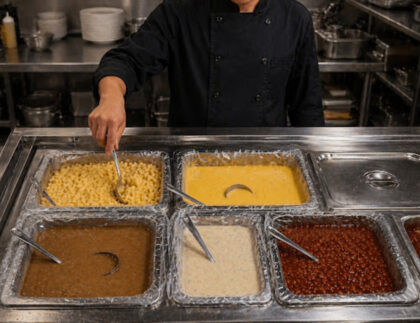
For steam table service, ScrubSaver Steam Table Pan Liners serve a different but related function. Designed for holding, transporting, and serving food at temperatures up to 220°F (not for oven use), ScrubSaver liners eliminate the direct food-to-metal contact that causes sticking and moisture loss on the serving line.
Food held on lined pans averages 20°F warmer than food in unlined pans, which helps maintain temperature and moisture during service. When a liner is removed after service, the pan still needs to be properly sanitized before its next use, but the soak-and-scrub step is gone. That time goes back to the team.
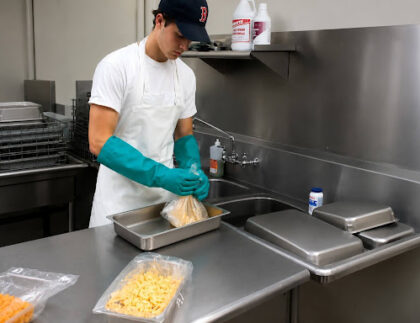
For districts operating centralized production kitchens or commissary models, where food is prepared at one location and distributed to satellite schools, the FlavorSaver Cook-Chill system can support batch production at scale.
Cook-chill allows kitchens to prepare items like soups, sauces, and proteins in volume, then package and rapidly chill them for distribution. Some of the largest K-12 operations in the country already use centralized cook-chill production. It fits naturally into districts looking to centralize labor, improve portion control, and maintain consistency across locations without duplicating preparation at every site.
None of these tools replaces skilled staff, good planning, or sound food safety practices. But for teams already doing all of that under real constraints, they reduce the friction that slows production down during the months when every minute matters most.
Conclusion
School Nutrition Directors carry a responsibility that extends well beyond any single meal. They manage people, budgets, schedules, compliance, and a production process that resets every day. During the busiest months, when meal counts peak and menus cycle through high-labor items, the operational margin gets thin.
What helps a program run smoothly during the busiest months is not a single piece of equipment or a staffing miracle. It is reliable systems, repeatable workflows, and practical tools that reduce unnecessary work without adding complexity.
PanSaver has been working alongside school foodservice operations for years because we understand what these teams are up against. Our products are built for exactly this kind of environment: high volume, tight timelines, and no room for wasted effort. If you want to see how PanSaver Ovenable Pan Liners, ScrubSaver Steam Table Pan Liners, or FlavorSaver Cook-Chill can support your program, request a free sample at pansaver.com, browse our education solutions, or contact us at (877) 726-7287 to talk about your operation.