That’s not because sustainability doesn’t matter. It does. But in 2026, the operators making real progress aren’t the ones chasing ESG language or branding campaigns. They’re the ones looking at their kitchens and asking a more practical question: where are we wasting time, labor, food, and money, and how do we stop?
That’s the shift. And it’s changing how smart foodservice operations think about sustainability from the ground up.
What Sustainability Looks Like in Foodservice in 2026
The pressure is real, and it’s coming from multiple directions at once.
Food costs are still elevated across most categories, and the economic cost of food waste in the global supply chain is forecast to reach $540 billion in 2026, according to a recent report by Avery Dennison. For the U.S. foodservice sector specifically, ReFED estimates surplus food costs operators roughly $147 billion annually.
Labor is the other pressure point. Technomic’s 2026 U.S. Foodservice Trends Forecast notes that the labor pool is shrinking, not stabilizing. Youth participation in the workforce has been declining for decades, and broader labor market shifts are making it harder and more expensive to staff a kitchen at any level.
When every labor hour costs more and finding qualified staff is harder, tasks that eat time without adding value to the guest experience, like extended pan scrubbing or manual urn sanitizing between service periods, become targets for immediate process improvement.
At the same time, ESG reporting expectations are growing. Larger operators are being asked by governing bodies and procurement teams to document sustainability progress. The days of a general commitment statement are fading. Numbers and outcomes are now expected. That pressure is showing up across:
- Non-commercial and institutional foodservice
- Healthcare and hospital cafeterias
- School nutrition programs
- Multi-unit and commissary operations
What all of this means in practice: operators can no longer afford to treat sustainability as a separate department or a PR initiative. When margins are thin and labor is scarce, sustainability has to pay for itself, or it doesn’t happen.
Why Operators Are Moving from ESG Language to Efficiency Metrics
The clearest sign of this shift is how the conversation has changed.
A few years ago, sustainability in foodservice was mostly about sourcing, packaging choices, and brand messaging. Today, according to 4xi Global Consulting’s 2026 analysis, the organizations leading on sustainability are the ones focused on measurable reductions in waste, operational changes that make economic sense under pressure, and systems that work in real kitchens, not just in reports.
The language is changing too. “Carbon footprint” is less useful than “labor hours saved.” “Eco-friendly” moves no one when utility bills are up. But “we cut cleanup time by 30 minutes per shift” or “we’re holding food at temperature for longer without adding equipment” gets a kitchen manager’s attention immediately.
Operators are evaluating every product, process, and procedure by whether it:
- Reduces waste
- Saves labor
- Prevents a cost from happening in the first place
When those evaluations are done honestly, efficiency and sustainability often lead to exactly the same answer.
Where Small Operational Changes Make the Biggest Impact
The good news: the highest-impact changes in most kitchens don’t require new equipment, new processes, or a sustainability manager. They come from looking at what’s happening at the pan, the steam table, and the end of every shift.
Here’s where the numbers add up fast.
Reduced scrubbing time:
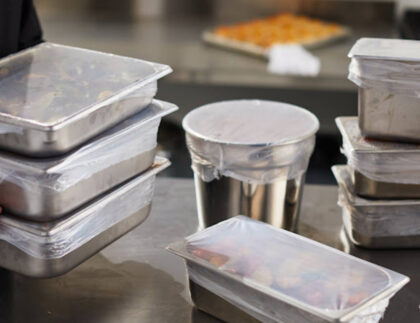
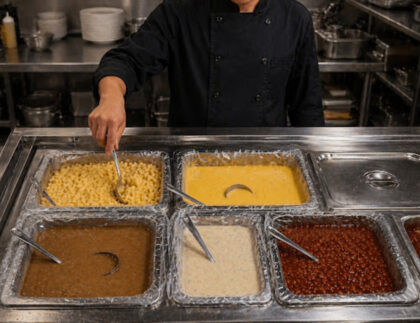
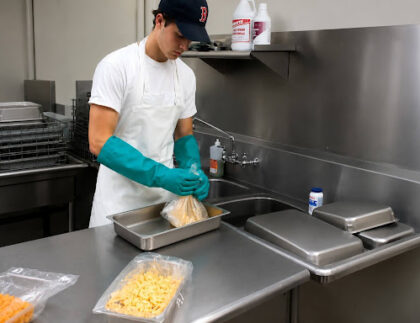
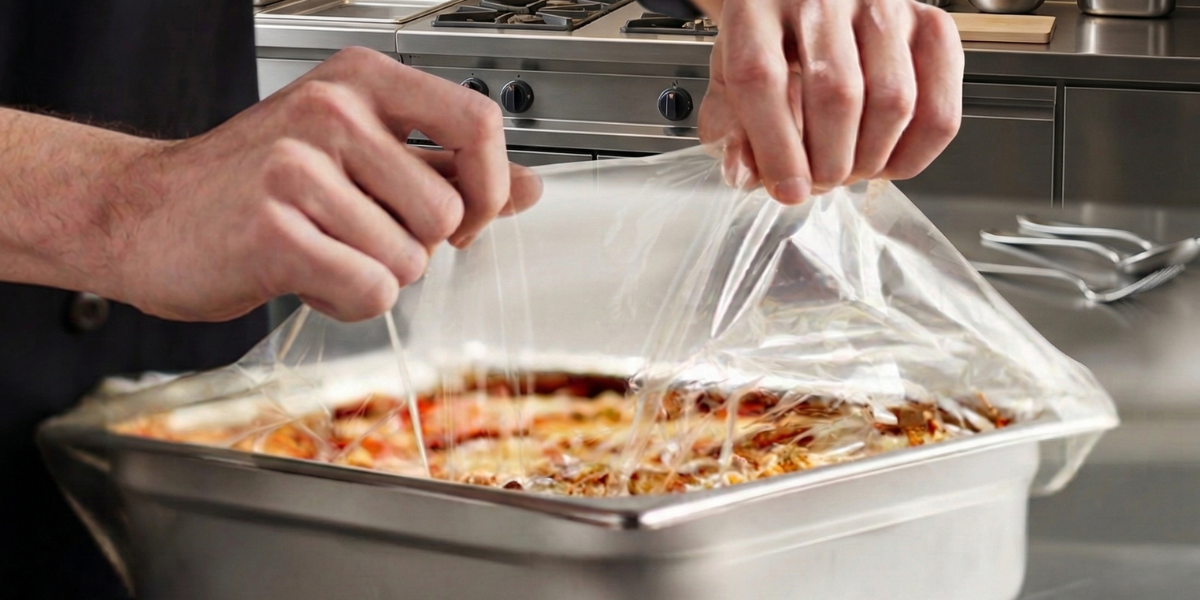
A single pan liner takes less than a minute to swap. Across a full-service day in a high-volume kitchen, that adds up to significant labor time redirected to higher-value tasks. The dish crew’s time is worth more than scrubbing baked-on food out of hotel pans, and protecting that time is both a labor and a food safety decision. Pan liners also support HACCP compliance by reducing cross-contamination risk between batches, which matters especially in school nutrition and healthcare foodservice, where documentation requirements are strict.
Better food yield:
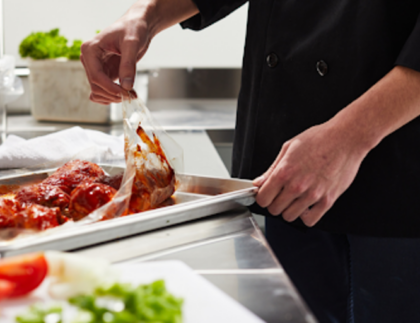
Food held in lined pans stays about 20°F warmer on average. That means less moisture loss, less scorching, and fewer discarded portions. Oven bags deliver a 7% greater yield compared to unlined roasting and cut cooking time by 33%. That’s energy savings and food savings at once.
Less food waste at the pan level:
PanSaver’s Contour-Fit pan liners fit tight to the corners of the pan, so food doesn’t get trapped or lost. In a high-volume operation, those recovered portions add up across the week.
Water and chemical reduction:
Every lined pan is a pan that doesn’t need extended soaking or harsh chemical treatments to clean. That reduces water usage and chemical costs on every cycle, while also extending the life of the equipment itself.
Cleaner beverage service, less sanitation time:
Beverage urn liners eliminate the need to manually sanitize urns between uses. In high-volume settings like schools, hospitals, and catering operations, that task happens multiple times a day. A liner swap takes seconds, keeps flavor consistent throughout service, and removes a repetitive step from an already stretched team.
Extended Cook-Chill shelf life:
Batch cooking with Cook-Chill bags gives kitchens up to a 28-day refrigerated shelf life. That means less spoilage, better portion control, and a more predictable cost structure. For commissaries, schools, and healthcare operations managing food across multiple sites, the operational and financial difference is significant.
None of these are dramatic or disruptive changes. That’s the point. They work on day one, they don’t require training programs, and the savings are immediate and measurable.
Sustainability That Works in Real Kitchens
There’s a version of sustainability that gets talked about in conference rooms and a version that actually happens behind the line. The gap between the two is usually one thing: whether or not the solution fits the reality of a working kitchen.
The most practical approach in 2026 is to stop treating sustainability as a goal that competes with operational performance and start recognizing that the two are largely the same thing. Reducing food waste is margin protection. Saving labor hours is cost control. Cutting water and chemical use is both an environmental outcome and a line item reduction.
For operators with formal ESG requirements, this framing also makes documentation easier. Measurable efficiency improvements, tracked against baseline, are exactly what auditors and procurement teams are looking for. Results carry more weight than intentions.
On the materials side, PanSaver RC pan liners are made with a minimum of 80% post-consumer recycled content and deliver the same performance as standard liners, including oven-safe use up to 400°F and the same Contour-Fit design. For operations looking for a bio-based option, PanSaver ECO uses up to 25% bio-based content with the same performance standard.
Both are made in the USA, NSF certified, and meet Halal, Kosher, FDA, and ISO 9001 standards. For operations that need to meet sustainability reporting benchmarks without changing their workflow, they fit without friction.
The goal isn’t to make sustainability the centerpiece of every kitchen decision. It’s to build kitchens where waste, inefficiency, and unnecessary labor are reduced as a matter of normal operations, and where the environmental outcomes follow naturally.
The Bottom Line
In 2026, the most practical kitchens are also some of the most sustainable ones, not because they’re chasing a label, but because they’ve built systems that waste less at every level.
Less food stuck in pan corners. Less time scrubbing at the end of a double. Less water running, fewer chemicals used, fewer portions discarded. Those are operational wins. They’re also sustainability wins. And they’re the kind that show up on the bottom line, not just in a report.
Small things add up. Whether it’s 3 minutes saved cleaning a pan or one extra serving recovered from every batch, those numbers compound over days, weeks, and months in any foodservice operation.
If you’re looking at where efficiency improvements are still on the table in your kitchen, start with what’s happening at the pan and the steam table. The savings are often closer than you think.
Request a sample and see for yourself. Browse PanSaver products, or contact us to talk through what works for your operation.