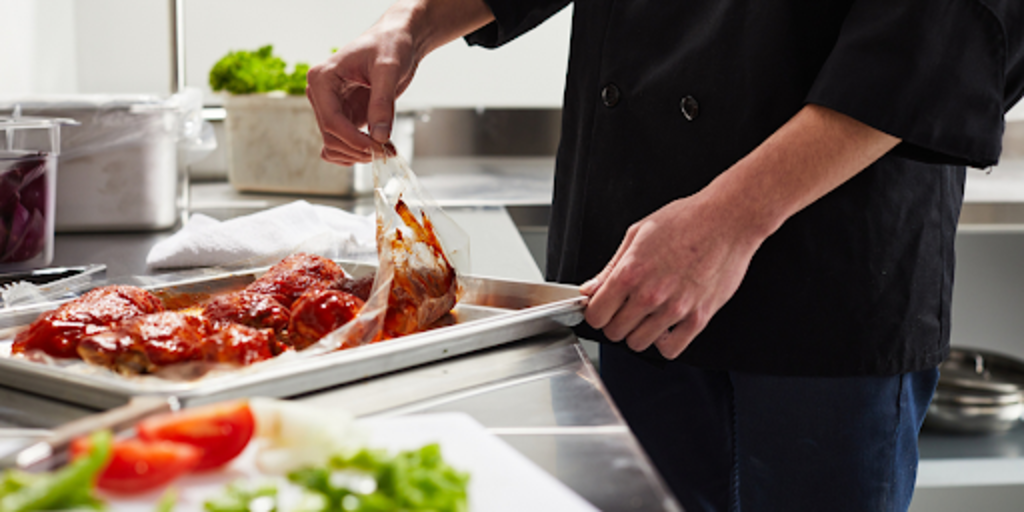
In most commercial kitchens, the constraints that slow meal production during high-demand periods are upstream. Prep workflows. Equipment availability. Pan cycling. The time it takes to clean, reprocess, and return equipment to production. Solving throughput problems by focusing only on the serving line is like clearing a traffic jam by widening the exit ramp while ignoring the bottleneck two miles back.
Sustainable throughput improvement means examining the full production cycle. Not just the final ten minutes of it.
Where Throughput Actually Breaks Down
The assumption that service speed determines throughput capacity is understandable. The serving line is what managers see when meals are moving slowly. But kitchen throughput is a system output that reflects everything that happened before a pan of food reached that line. Most kitchen teams underestimate how far back the chain of causation actually runs, whether the operation is a high-volume restaurant, a commissary, a school nutrition program, or a clinical kitchen running on fixed meal schedules.
Three areas consistently create the most significant drag during peak periods:
Prep workflow timing: When prep tasks are not sequenced to align with production needs, delays compound quickly. A protein that takes longer than expected to reach temperature, a sauce that ties up a burner needed for the next item, a garnish station that isn’t stocked before service begins: each of these creates gaps that extend service windows and reduce total output.
Pan and equipment availability: One of the most underestimated constraints in high-volume kitchens. If pans are tied up in production, waiting to be cleaned, soaking in the dish pit, or still too hot to handle, the kitchen cannot start the next batch. The line stops not because staff isn’t working, but because the equipment needed to continue isn’t there.
Cleanup time requirements: The longer it takes to clean a pan, the longer the gap between batches. In kitchens running multiple items across shared equipment, that gap multiplies. Heavy baked-on residue, protein buildup, and starch deposits on steam table pans compete directly with production continuity.
These three variables interact constantly during peak service. Fixing one in isolation produces marginal gains. Fixing them as a system is where real throughput improvement comes from.
The Pan Turnaround Problem
Pan turnaround is not a glamorous topic in foodservice management. It is, however, one of the most consequential ones that consistently goes unexamined.
In operations running continuous meal production, pans are among the most cycled pieces of equipment in the kitchen. They move from prep to oven to hot holding to service to the dish room. How long that cycle takes, and how reliably it repeats, directly determines how many batches a kitchen can complete in a given production window.
When pan turnaround slows, the effects cascade immediately. A kitchen running low on available hotel pans delays the next batch. That delay affects stocking levels on the serving line. Which affects service pace. Which affects the ability to serve the volume expected in the time allotted.
In commissary operations and high-volume institutional kitchens, that cascade can mean the difference between completing a full production schedule and falling short. In hospitals and care facilities operating on fixed meal delivery windows, the margin is even tighter. In operations supplying multiple sites or distribution points, a pan availability gap at 7 a.m. can affect delivery completeness three hours later.
What makes this particularly difficult to address is that pan availability issues rarely surface in any report. Unlike a food cost variance or a labor overrun, a delayed batch caused by a pan sitting in the soak sink does not generate a line item. The time disappears quietly into the shift, never flagged, never measured, never corrected.
Cleaning Time as a Production Variable
Most kitchen managers track labor hours, food cost, and portion yield. Fewer treat pan cleaning time as a production variable. It is one.
When a pot washer or prep cook spends an extra eight minutes soaking and scrubbing a heavily soiled hotel pan, the cost is not just labor. It delays pan availability. In a tight production schedule, that delay means a delayed batch. Multiply that across a full shift and the aggregate loss is significant, even if no single instance seems worth flagging. In operations where meal timing is tied to clinical care or regulatory requirements, the downstream cost of that delay extends well beyond the kitchen.
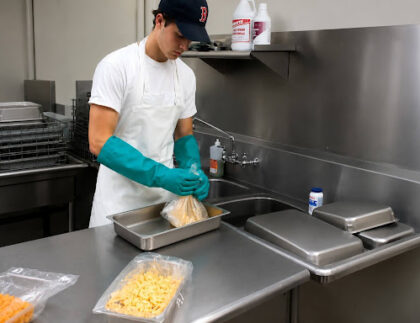
Reducing cleanup intensity is not about cutting corners on sanitation. It is about recovering time that has no production value. When pans come out of the oven with less baked-on residue, they move through the dish cycle faster, return to the production line sooner, and reduce the friction between batches.
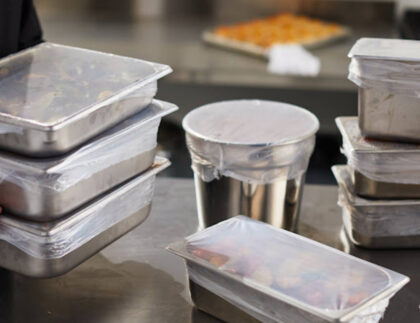
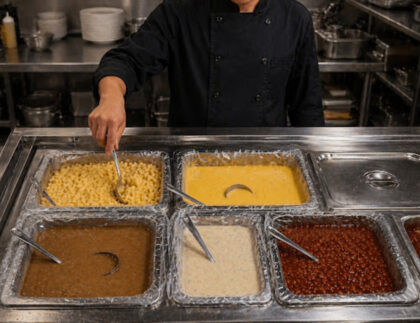
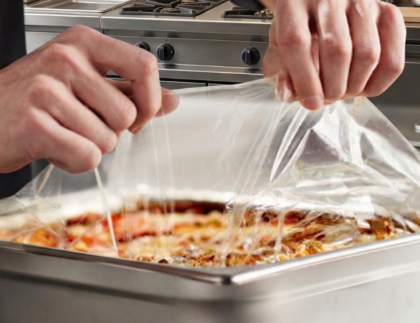
Solutions designed to minimize food-to-metal contact during cooking, ovenable pan liners being the most direct example, work precisely because they attack this variable at its source. The liner lifts out, takes the residue with it, and the pan is ready for the next cycle in a fraction of the usual time. Across dozens of pans per shift, that recovery adds up in ways that are genuinely measurable.
Healthcare Foodservice and the Cost of a Missed Window
Healthcare foodservice operates under constraints that most commercial kitchen environments simply do not face. Meal delivery in a hospital or long-term care facility is not governed by customer preference or dining traffic patterns. It is governed by clinical schedules, patient care routines, and in many cases, regulatory expectations around meal timing and nutritional delivery.
Patients on modified diets, those recovering from procedures, or those on time-sensitive medication schedules cannot wait for the next service round. A late meal in this setting is not a service inconvenience. It can affect medication timing, dietitian-coordinated care plans, and patient satisfaction scores that carry real institutional weight.
Production Volume Without Staffing Flexibility
Healthcare kitchens routinely produce hundreds of individual meals across multiple diet types, temperature requirements, and delivery windows. Most operate within a two to three hour production window, twice a day, with staffing levels that would seem lean by any commercial standard.
In that environment, a bottleneck anywhere in the production cycle has consequences that extend well beyond the kitchen. A pan availability problem during breakfast production delays tray assembly. Delayed tray assembly delays cart loading. Delayed cart loading means delivery to patient floors starts late, which disrupts the morning routine across multiple units simultaneously.
This is not a hypothetical. It is a routine operational risk in healthcare foodservice, and experienced directors know it. The production cycle has to work reliably every day, not most days.
Pan Availability as a Patient Care Variable
The link between pan turnaround and patient meal timing is direct. When pans cycle slowly through the dish room, production staff cannot load the next batch. Hot food programs fall behind. Tray assembly starts late. Delivery carts leave late.
Operations that have shortened pan turnaround time through workflow changes, equipment adjustments, or liners that reduce cleaning requirements consistently report improvements in on-time delivery. No single step produces a dramatic change. The gains are incremental and they compound.
For healthcare foodservice managers looking for throughput improvements that require no additional headcount, no capital expenditure, and no changes to menu or clinical diet protocols, pan availability and cleanup efficiency are among the highest-return areas to examine. The infrastructure is already there. The friction just needs to be removed.
Maintaining Quality While Increasing Speed
There is a real tension in this. Pressure to move faster during peak service is legitimate, and it sometimes leads to decisions that trade quality, portion accuracy, or safety protocols for speed. Those are not throughput improvements. They are deferred problems that show up downstream as complaints, waste, or rework.
The actual goal is narrower: find where time is being lost without adding value, and recover it without touching the variables that determine food quality and safety.
Pan turnaround time is one of those recoverable variables. Time spent soaking a heavily soiled pan does not improve the food. It does not increase portion accuracy or contribute anything to the flavor, texture, or safety of the next batch. It is a pure recovery cost. Reducing it through better pan management or tools that minimize residue buildup gets that time back without making any trade-off worth worrying about.
Prep workflow sequencing works the same way. Time lost to poor sequencing does not improve the food. Recovering it through better scheduling, parallel tasking, or tighter mise en place increases production capacity without changing anything about what is being served.
Consistency as a Throughput Asset
Consistency in portion sizes, cooking times, and service presentation is a quality standard. It is also a throughput asset, and the second function tends to get overlooked.
When portions are consistent, line staff move through service without hesitation or mid-service correction. When cooking times are reliable, production staff can schedule batches with real confidence rather than rough estimates. When presentation standards are clear and achievable, tray assembly runs without the delays that quality checks and rework create.
Operations that treat consistency as an operational discipline, not just a quality requirement, run more efficiently during peak periods. They have reduced the decision points that slow service down. The food is ready when it is supposed to be, in the form it is supposed to be in.
Consistency also supports labor efficiency in a way that rarely gets discussed directly. When production outcomes are predictable, less experienced staff can execute tasks without requiring supervision at every step. That frees senior kitchen personnel to manage flow, address exceptions, and keep the broader production schedule moving. In lean-staffed operations, that kind of flexibility is not a nice-to-have.
Building a Faster Kitchen Without Losing What Matters
Throughput improvement in high-volume foodservice is a systems problem. The serving line, the prep schedule, the dish cycle, the equipment rotation: they are all connected. Improving one element without considering its relationship to the others produces limited results. Most operations that struggle with peak-period throughput are not failing at any single thing. They are losing small amounts of time across several connected steps, and the losses accumulate.
Operations that have made meaningful gains tend to share a few practices in common. They have mapped the full production cycle and looked for where time disappears between steps, not just within them. They treat pan availability as a production variable and have taken steps to close the gap between when a pan leaves the oven and when it returns to use. They have reduced cleanup intensity without compromising sanitation. And they have aligned prep sequencing with their actual production schedule rather than with how things have always been done.
Some operations have found value in running informal time studies during peak shifts, not to monitor staff, but to find where minutes are going. The findings are often surprising:
- A dish cycle running four minutes longer than expected due to pan soak time
- A cooling rack positioned too far from the dishwasher, adding unnecessary steps
- Pans sitting in a soak tank for twenty minutes before anyone gets to them
- Batch starts delayed not by staff readiness but by equipment availability
None of these appear on a report. Together, they can represent a substantial amount of lost production time each week.
Tools like ovenable pan liners support this kind of workflow improvement by reducing the cleanup burden on individual pans, shortening the turnaround cycle, and keeping production equipment available when it is needed.
PanSaver’s pan liners are designed specifically to minimize food-to-metal contact, which reduces baked-on residue and accelerates the cleaning process. In a kitchen running thirty or forty hotel pans per shift, that adds up to something real.
Tools, though, are only part of the answer. The more foundational shift is treating throughput as a whole-system concern rather than a serving-line problem. When kitchens make that shift, they tend to find that meaningful speed improvements were available the entire time. They just were not visible from the front of the line.
If you want to test whether pan liners can meaningfully reduce turnaround time in your operation, PanSaver offers samples. Browse the full product line at pansaver.com or contact the team to talk through what fits your kitchen.