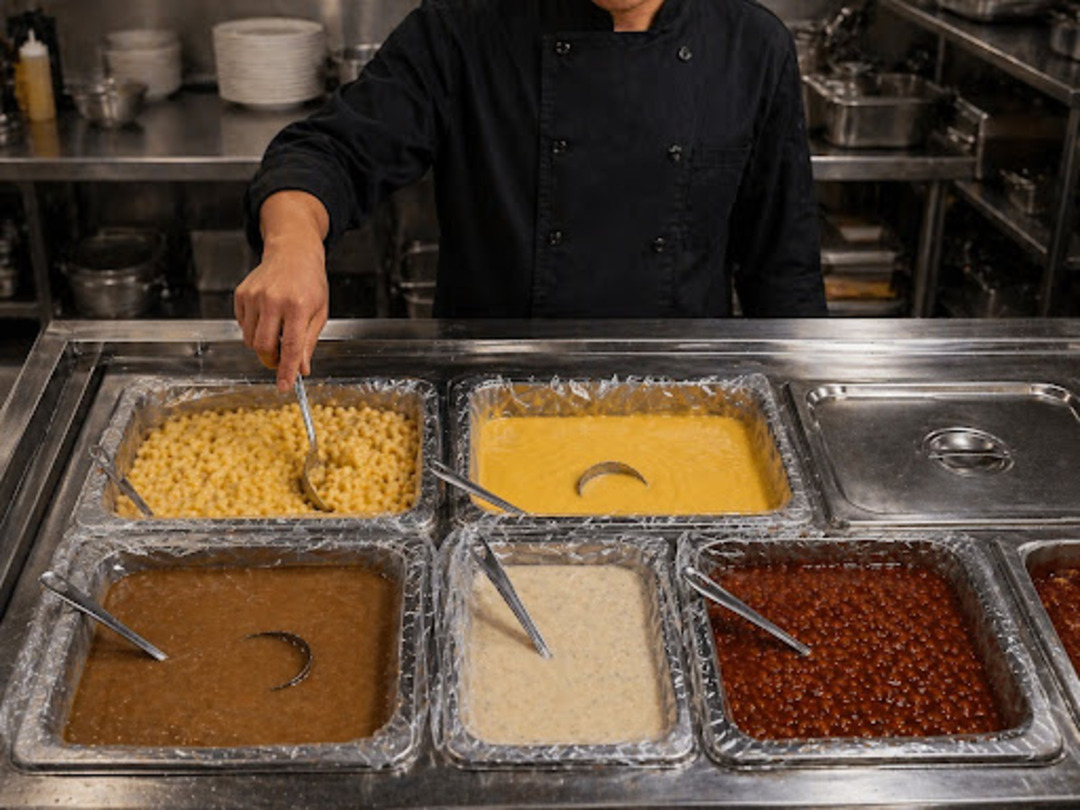
That’s the problem with pan scrubbing. It doesn’t announce itself as a cost. It hides inside labor hours, water bills, chemical spend, workflow bottlenecks, and end-of-shift overtime. And in an industry where net margins typically run between three and eight percent of sales, the gap between a profitable month and a losing one is thin enough that hidden costs like these can close it.
Why Pan Scrubbing Costs More Than You Think
Most operators know that scrubbing pans takes time. What gets missed is the chain reaction that time sets off.
When a cook or dishwasher stands at the sink working on a soiled steam table pan, they’re unavailable for anything else. Not restocking the line. Not portioning for the next batch. Not breaking down a station. Just scrubbing.
According to warewashing industry data compiled and published by Ecolab, hand scrubbing pots and pans in a three-compartment sink averages three to five minutes per item. For a kitchen cycling through 30 to 50 steam table pans in a day, that’s a significant block of labor locked into a task that produces zero revenue.
And labor is already the single largest operating cost in most foodservice operations. The National Restaurant Association’s 2025 Restaurant Operations Data Abstract, based on data from more than 900 operators, found that salaries and wages (including benefits) represented a median of 36.5 percent of sales for full-service restaurants in 2024.
Profitable full-service operators held that number closer to 34.2 percent. That gap of just over two percentage points doesn’t sound like much until you realize it’s often the entire difference between the operators who made money last year and the ones who didn’t.
When labor runs at those levels, spending employee time on avoidable scrubbing is a habit most operations can’t afford.
Breaking Down the Real Cost Categories
Pan scrubbing doesn’t just cost labor. It draws from several areas of the operation at once, and the overlap is part of what makes it so easy to underestimate.
Labor Hours and Wages
This is the most visible cost, but few operators have ever actually done the math on it. Consider a simple illustrative scenario: if a kitchen runs through 40 steam table pans per day and each pan requires an average of four minutes of soaking, scrubbing, and rinsing, that’s 160 minutes. Nearly three hours of labor, every day, dedicated to one task. At $15 per hour (a conservative figure in many markets), that’s roughly $45 per day, or over $16,000 per year in a seven-day operation.
In reality, many urban markets now pay well above that rate, and the true all-in cost of labor, including benefits, taxes, and workers’ compensation, pushes the number higher. This is an illustrative example, not an industry average. Your actual numbers depend on your volume, your menu, and how soiled your pans get. But the compounding works the same way in every kitchen.
Water and Chemical Consumption
What most operators overlook here is how water, energy, and chemicals all fire simultaneously during manual scrubbing.
The EPA estimates that 52 percent of water use in restaurants is associated with kitchen and warewashing operations. A typical sit-down restaurant uses roughly 5,800 gallons of water per day. Hand scrubbing in a three-compartment sink is particularly water-intensive because it requires frequent refills as water cools and gets dirty. Each refill can use 120 gallons of hot water, and those refills happen every two to four hours during active warewashing, according to industry data published by Ecolab.
Layer in detergents, degreasers, and sanitizers, and pan cleanup becomes a line item that touches five cost categories at once: labor, water, energy (to heat the water), chemicals, and sewer fees. No single one looks alarming by itself. Together, they add up quietly.
Pan Availability and Turnover
This is the cost that almost never gets discussed, but operationally it matters more than people expect. A pan sitting in a soak sink is a pan that’s not on the steam table. In high-volume operations like school cafeterias, commissary kitchens, or catering companies, pan availability directly affects the ability to hold, serve, and rotate food on schedule.
If dirty pans stack up faster than they can be scrubbed and returned, the operation has two choices: slow down service or buy more pans. Neither is free. Slow pan turnover creates bottlenecks, forces workarounds, and inflates the cost of maintaining a pan fleet that wouldn’t need to be as large if turnaround were faster.
The Staffing Pressure Underneath It All
Commercial kitchen labor costs aren’t just about dollars per hour. They’re about what you can get done with the crew you actually have on the floor.
According to the National Restaurant Association, roughly seven in ten operators still report having job openings they can’t fill. Annual turnover in the restaurant industry runs close to 80 percent, up from approximately 72 percent before the pandemic, based on Bureau of Labor Statistics data. Most kitchens are already running leaner than they’d like to be.
In that environment, assigning experienced staff to repetitive cleanup carries a real opportunity cost. Every hour a line cook or prep cook spends scrubbing pans is an hour they’re not prepping, portioning, or supporting service. For dishwashers, the picture is different but equally important: excessive scrubbing workloads contribute to the physical fatigue and job dissatisfaction that drive turnover even higher.
The real issue isn’t that scrubbing takes time. It’s that the time it takes is invisible in most labor reports. You won’t see “pan scrubbing” as a line item. But you’ll see it in overtime at the end of the night, in prep that didn’t get finished, in the frustration of a dish crew that’s still at the sink while the front of house has already locked up.
How Cleanup Disrupts Workflow and Closing Routines
In a well-run kitchen, the end of service should transition smoothly into closing. Stations get broken down, equipment gets cleaned, food gets stored, and the team gets out at a reasonable hour.
Heavy pan scrubbing breaks that rhythm. It creates a bottleneck at the dish station that backs up everything else. The sink fills with soaking pans, leaving less room for other items. One or two staff members get locked into scrubbing while other closing duties stretch out because fewer hands are available.
What few operators account for is how this effect multiplies across locations. A franchise group running 20 locations, each losing 30 minutes to avoidable scrubbing at close, is giving up 10 hours of labor per night across the system. Over a year, that’s more than 3,600 hours of cumulative labor spent on a task that could be reduced.
Reducing the Scrubbing Load with ScrubSaver Steam Table Pan Liners
If the cost of scrubbing comes from food baked onto metal, one practical approach is to keep food from contacting the pan in the first place. That’s what ScrubSaver Steam Table Pan Liners from PanSaver do.
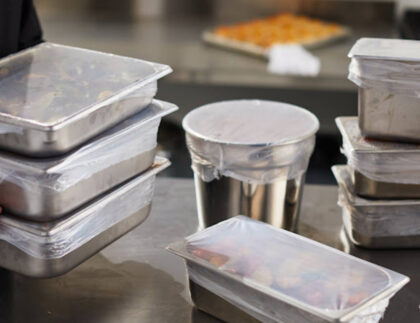
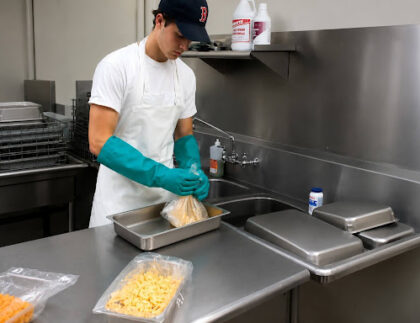
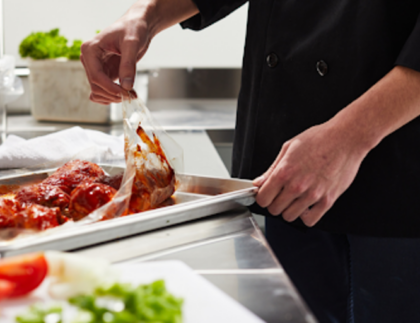
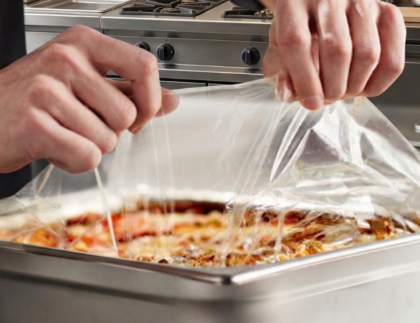
These disposable liners fit inside standard steam table pans, creating a barrier between the food and the pan surface. When service is over, the liner comes out and goes in the trash. The pan is ready to sanitize and line again immediately. No soaking. No scrubbing.
ScrubSaver liners are designed for holding, transporting, and serving food from steam tables, and for keeping food warm or reheating it in a steamer up to 220°F. They are not oven liners. PanSaver makes separate ovenable pan liners rated to 400°F for cooking applications.
The operational benefits are straightforward:
- Less scrubbing means less labor tied to cleanup. Staff can be reassigned to prep, portioning, or other productive work.
- Faster pan turnover. A pan that doesn’t need soaking is back in rotation in seconds, not minutes.
- Reduced water and chemical use. Less scrubbing means fewer sink fills, less hot water, and less degreaser per shift.
- Virtually no food waste. Food doesn’t stick to the liner surface, and with no direct food-to-hot-metal contact, it stays approximately 20°F warmer on average.
- Cleaner pan surfaces between uses. Food never touches the metal, so there’s no residue left behind when the liner comes out.
ScrubSaver liners won’t replace every cleaning task in your kitchen. Pans still need to be sanitized between uses. But they can take the heaviest, most time-consuming part of the job off your team’s plate. In a labor market where every productive minute counts, that’s not a small thing.
A Cost Worth Measuring
Pan scrubbing is one of those tasks that feels permanent. It’s always been part of the job, so it stays invisible on the cost sheet. But the labor, water, chemicals, and lost productivity that go into scrubbing dozens of steam table pans every day are not fixed costs. They’re controllable, and they respond to practical changes.
ScrubSaver Steam Table Pan Liners from PanSaver are one way to reduce that load. Made in the USA, trusted by restaurants, schools, hospitals, and commissaries nationwide. No training required. Line it, use it, toss it.
If you want to see how they work in your operation, request a sample at pansaver.com.