The operations that handle this well aren’t necessarily bigger or better funded. They’ve just figured out where the pressure will hit before it arrives and made adjustments while there was still time to make them. Here’s what that preparation actually looks like.
Start with the Calendar, Not the Menu
Most holiday prep conversations jump straight to the menu. That’s the wrong starting point.
The first question is logistical: when will volume spike, how many of those spikes overlap, and which ones compete for the same resources? Map out confirmed and projected catering orders alongside your regular production calendar for November and December. Look at where large-batch catering prep will fight with daily service for oven time, cooler space, and staff hours.
A catering order for 200 portions of carved turkey on the same day your restaurant runs a full dinner service is a fundamentally different problem than that same order landing on a slower Monday. The calendar makes that visible.
For multi-unit operations and foodservice directors overseeing several sites, this exercise also surfaces a bigger question: should production be centralized at a commissary kitchen or distributed across locations? That decision cascades into purchasing, transport logistics, and food safety planning. Get it wrong and you’re solving the same problem at every site instead of solving it once.
Decide What Gets Made Ahead
Once you know when the volume hits, figure out how much of that work can shift to a quieter day.
Soups, sauces, gravies, braised proteins, mashed potatoes: these are natural candidates for advance production. The challenge isn’t identifying them. It’s having a reliable method for holding that food safely over days, not just hours.
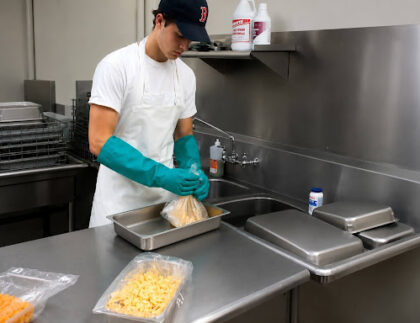
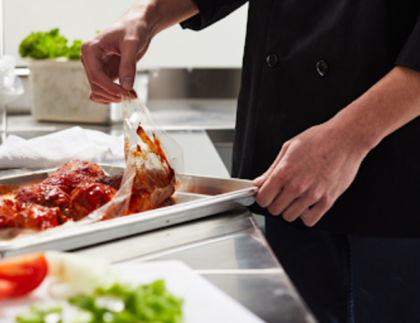
Cook-chill is one of the most practical approaches for operations that need to separate production from service by more than a day or two. Food is cooked, portioned into sealed bags, rapidly chilled, and stored under refrigeration until needed. Done properly, the closed-bag system safely and efficiently stores food, which gives kitchens real flexibility in scheduling their heaviest prep work well ahead of peak days.
FlavorSaver cook-chill bags from PanSaver are built for this workflow. They handle hot-fill directly from the kettle, withstand rapid chilling in tumble or ice-bath systems, and store at temperatures down to 0°F (or -40°F in high-heat nylon versions). The sealed barrier film prevents oxygen transfer and flavor crossover between stored products, so a hearty beef stew can be stored next to a delicate butternut squash soup without impacting the flavor. The bags carry NSF, Kosher, and Halal certifications and are BPA-free.
Not every kitchen has a full cook-chill setup, and that’s fine. Even identifying three or four menu components that can be prepped 48 to 72 hours ahead and safely held under refrigeration takes real pressure off peak production days. The point is to stop treating every item as a same-day cook.
Audit Your Equipment and Pan Inventory Before You Need Them
A broken combi oven in July is an inconvenience. A broken combi oven the Tuesday before Thanksgiving is a crisis. Schedule preventive maintenance and any known repairs for October, well before holiday production ramps up. This is obvious advice that a surprising number of kitchens still skip.
The less obvious bottleneck is pans. Hotel pans are the workhorses of catering production, and most kitchens don’t have as many clean, undamaged ones available as they think they do.
Count what you actually have in usable condition across full, half, and third sizes. Then factor in that catering ties up pans for longer stretches than daily service does. A pan holding carved turkey on a buffet line is unavailable for the next prep task until someone scrubs it out, and that turnaround time compounds fast when you’re running multiple events in the same week.
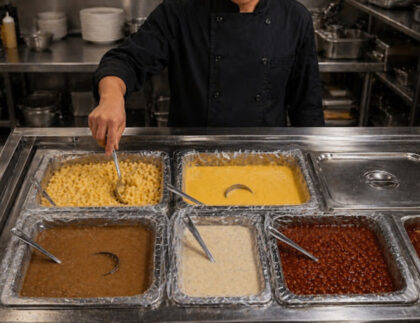
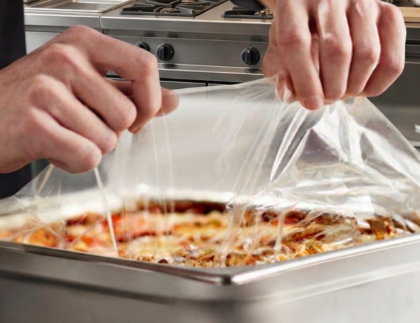
This is where pan liners shift the equation. PanSaver ovenable pan liners are rated to 400°F and fit standard hotel pan sizes. When the food is served, the liner lifts out and the pan is ready for the next use with minimal cleaning. During high-volume catering production, that turnaround difference across dozens of pans can free up hours of labor that would otherwise go to soaking and scrubbing.
The liners also prevent direct contact with the hot metal surface, which helps retain moisture. Food held on lined pans stays an average of 20°F warmer. On a steam table during extended catering service, that’s the difference between a dish that still looks and tastes right at the 90-minute mark and one that’s starting to dry out.
Plan for Holding, Transport, and Offsite Service
Catering frequently requires food to travel, and the gap between cooking and serving introduces risks that don’t exist in a standard restaurant service. Most food quality and safety problems in catering don’t happen during cooking. They happen during the wait.
The FDA Food Code is specific:
- Hot foods must be held at 135°F or above.
- Cold foods must stay at 41°F or below.
- Food reheated for hot holding must reach 165°F for 15 seconds within two hours.
These aren’t suggestions. They’re the rules health inspectors enforce, and the margin for error tightens when food is moving between a production kitchen and a catering venue in insulated carriers.
Two practical details that often get overlooked:
Covering and transport
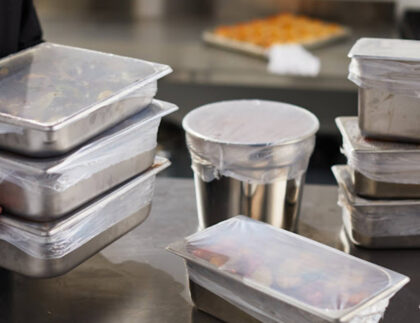
Standard aluminum foil can loosen, tear, or collapse under stacking, creating both a food safety and a presentation problem at the venue. PanSaver Shrink-Tight™ pan covers are made from BPA-free, NSF-listed nylon that shrinks tightly around the rim of a hotel pan after a few seconds in the oven. The result is a secure, stackable seal rated to 400°F. The film is clear and markable, so staff can see the contents and label pans without opening them. When your van is loaded with 30 pans and the catering team needs to identify items on arrival, that small detail saves real time.
Reheating at the venue
If you’re relying on a client’s oven or rented chafing equipment, test that workflow in advance. An underpowered warmer that holds food at 120°F instead of 135°F turns a well-planned menu into a food safety problem. Assume nothing about offsite equipment until you’ve confirmed it.
Staff the Work, Not Just the Shift
Holiday staffing conversations tend to focus on headcount. Schedule more people. Problem solved. Except it isn’t.
The real question is whether the people on the schedule can do the work that needs to happen during their specific shift. Catering prep, assembly, transport, and setup require different skills and task sequences than line cooking. A strong sauté cook may not be efficient at portion-packing 150 boxed lunches. An experienced line team may have never loaded a catering van or set up a buffet station at a venue they’ve never seen.
Instead of simply adding hours, map the actual tasks each shift needs to complete during peak catering weeks. Then match the work to the right people:
- Assign predictable assembly and packing work based on training, availability, and workflow needs.
- Reserve specialized production tasks for team members whose experience is essential to quality and execution.
- Look for routine tasks that pull experienced staff away from work that specifically requires their expertise. Those tasks are usually the easiest to reassign or simplify.
That last point matters more than most operators realize. A 2025 Expert Market report found that 82% of U.S. restaurant and foodservice businesses were actively hiring, with chef and cook positions accounting for 30% of open roles.
Skilled labor is scarce. If your most experienced cook is spending part of every shift scrubbing sheet pans or packing to-go containers, that’s skilled labor going to work that doesn’t require it.
Build Slack into the Plan
The biggest risk in holiday catering isn’t any single problem. It’s what happens when two or three small problems hit the same day and there’s no margin to absorb them.
A delivery arrives 45 minutes late. A catering order jumps from 80 to 120 covers two days before the event. The walk-in is so packed with advance prep that incoming produce has nowhere to go. Each one is manageable alone. Stack them on the same Thursday in November and the operation falls behind in ways that are hard to recover from mid-shift.
Build contingency into the schedule rather than planning every day at full capacity. A few buffers worth building in:
- Shift prep earlier. If a batch of soup can be made Tuesday or Wednesday for Friday service, make it Tuesday. Wednesday becomes available for the problem you didn’t see coming.
- Stock supplies beyond the plan. Keep a small reserve of clean pans, liners, covers, and packaging beyond what your production schedule calls for. Running out of half-size hotel pans during a catering push is an avoidable problem that creates real delays.
- Create a flex role. Assign one person per shift during peak weeks who isn’t locked into a station and can move to wherever pressure builds, whether that’s portioning, loading, cleaning, or handling a last-minute add-on order.
The operations that survive holiday season with their standards intact aren’t the ones where nothing goes wrong. They’re the ones that built room for it.
Preparation Beats Reaction
Holiday catering season rewards the kitchen that thinks through the operation before the first big order lands. Every decision made early, what gets prepped ahead, how pans cycle through production, how food stays safe during transport, where staff time actually goes, is one fewer problem to solve at 4 p.m. on a Friday in November.
The work isn’t complicated. It’s just a lot easier to do in October.
PanSaver products, from pan liners and oven bags to cook-chill bags and Shrink-Tight™ pan covers, are built for the realities of high-volume foodservice production. To see how they fit your operation, browse the full product line or request a sample.